Breaking Barriers: Blue Origin’s Historic All-Female Spaceflight and Its Global Impact
 |
| Source : https://www.themarysue.com/wp-content/uploads/2025/04/blue-origin-women-copy.jpg?w=768 |
🚀 Introduction
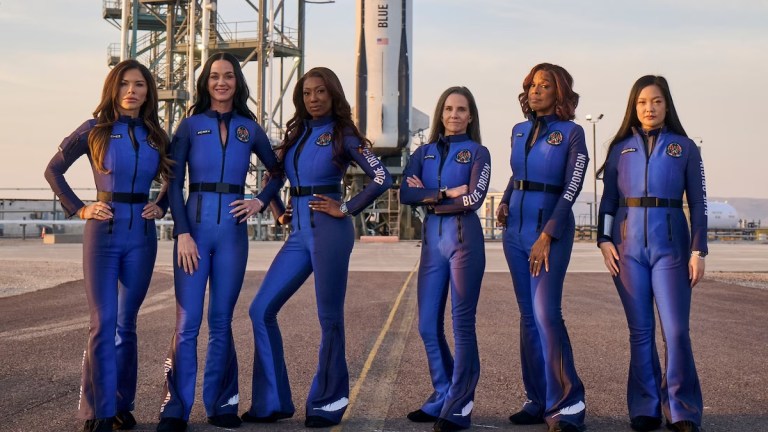
In a groundbreaking moment for both space travel and gender equality, Blue Origin recently launched its first all-female spaceflight, marking a monumental step toward inclusive exploration of the final frontier. This mission, carried out by the company’s New Shepard rocket, brought together a diverse group of women from different professions and backgrounds, symbolizing the expanding reach and promise of modern space science.
But this was more than just a joyride to suborbital space. It was a statement. A message to the world that space is for everyone — and that the future of exploration must be as diverse as the planet we live on.
🌌 The Legacy of Women in Space
The journey of women in space began in 1963 when Valentina Tereshkova, a Soviet cosmonaut, became the first woman to orbit Earth. Decades later, NASA astronaut Sally Ride broke the gender barrier for the U.S. in 1983. While these were iconic milestones, progress remained slow. Women have long been underrepresented in both astronaut corps and aerospace leadership roles.
This mission by Blue Origin pays homage to those pioneers and pushes the envelope further. Unlike earlier missions driven by government space agencies, this was a private endeavor — making it even more symbolic of changing tides in both gender dynamics and the privatization of space travel.
👩🚀 Meet the Trailblazing Crew
The flight’s six-member crew included a vibrant mix of artists, journalists, engineers, and philanthropists:
-
Lauren Sánchez: Journalist, pilot, and partner of Blue Origin founder Jeff Bezos. She led the crew with both grace and grit.
-
Gayle King: Renowned broadcast journalist known for her role on “CBS Mornings.”
-
Aisha Bowe: Former NASA engineer and founder of STEMBoard, an advocate for women and minorities in STEM.
-
Katy Perry: Global pop icon and UNICEF goodwill ambassador, using her platform to inspire young girls.
-
Amanda Nguyen: Civil rights activist and Nobel Peace Prize nominee, bringing attention to social justice issues.
-
Kerianne Flynn: Philanthropist with a passion for education and equity.
Their inclusion wasn’t just symbolic. Each brought a unique perspective to the mission, emphasizing how space exploration is no longer confined to scientists and astronauts alone.
🚀 The Flight: A Closer Look at New Shepard
 |
| Credit : Blue Origin Images |
Blue Origin’s New Shepard rocket is designed for suborbital space tourism. The rocket took off from West Texas, carrying the crew about 66 miles (106 kilometers) above Earth’s surface — past the Kármán line, the internationally recognized boundary of space.
The entire mission lasted around 11 minutes, during which the crew experienced a few minutes of weightlessness. Despite its brevity, the flight offered profound experiences — including seeing the curvature of the Earth and the vastness of space.
Technical Highlights:
-
Fully autonomous flight
-
Reusable rocket booster
-
Capsule returned via parachute
-
Smooth, successful landing
💫 Why This Mission Matters
1. Representation Matters
For decades, spaceflight was largely a male-dominated field. This mission challenges that narrative, showing that space is no longer reserved for a specific demographic.
2. Public Inspiration
Seeing familiar faces like Katy Perry and Gayle King in space helps bridge the gap between science and popular culture, inspiring a new generation to dream big.
3. STEM Advocacy
Aisha Bowe’s participation is particularly significant. As an engineer and entrepreneur, her story empowers young women of color to pursue careers in science, technology, engineering, and math.
4. A Statement for Equity
Amanda Nguyen’s presence brought social justice into orbit. Her advocacy reminds us that progress in one field should inspire inclusion in all.
📢 Public and Scientific Reactions
The mission was met with widespread acclaim across social media and news outlets. Hashtags like #WomenInSpace and #BlueOriginFlight trended worldwide, and major networks provided live coverage.
Experts in space policy noted the mission’s importance in shaping public perceptions and influencing future space initiatives. NASA Administrator Bill Nelson even tweeted his support, highlighting the mission’s “historic and inspirational” nature.
Critics, however, pointed out the elitism of space tourism, suggesting that it remains an endeavor for the wealthy. Still, many agree that such missions are helping normalize civilian space travel and lay the groundwork for broader accessibility.
🌍 What’s Next for Women in Space?
This mission is just one step in a much larger journey. Here’s what’s on the horizon:
-
NASA’s Artemis Program aims to land the first woman on the Moon by 2026.
-
Commercial space companies are increasingly hiring women engineers, pilots, and mission directors.
-
STEM education initiatives are being launched globally to prepare the next generation of female explorers.
Additionally, organizations like Women in Aerospace, Space4Women, and STEM for Her are gaining momentum, providing scholarships, mentorship, and advocacy.
✨ Conclusion
Blue Origin’s all-female spaceflight wasn’t just a launch — it was a leap forward. A leap that said: women belong in space, in command, in every part of the mission. It highlighted not just how far we’ve come since Valentina Tereshkova’s solo flight in 1963, but how far we still have to go.
From symbolic to strategic, from cultural to scientific — this mission redefines what space travel looks like in the 21st century. As we set our sights on Mars, the Moon, and beyond, one thing is clear: the future of space is diverse, inclusive, and female-powered.



No comments:
Post a Comment