The OSIRIS-REx mission's precious cargo is more than just space rocks—it's a time capsule containing the very building blocks that may have sparked life on Earth.
 |
| Image Link: https://assets.science.nasa.gov/dynamicimage/assets/science/psd/solar/internal_resources/5264/Asteroid_Bennu-1.jpeg?w=800&h=600&fit=clip&crop=faces%2Cfocalpoint |
The Moment of Discovery
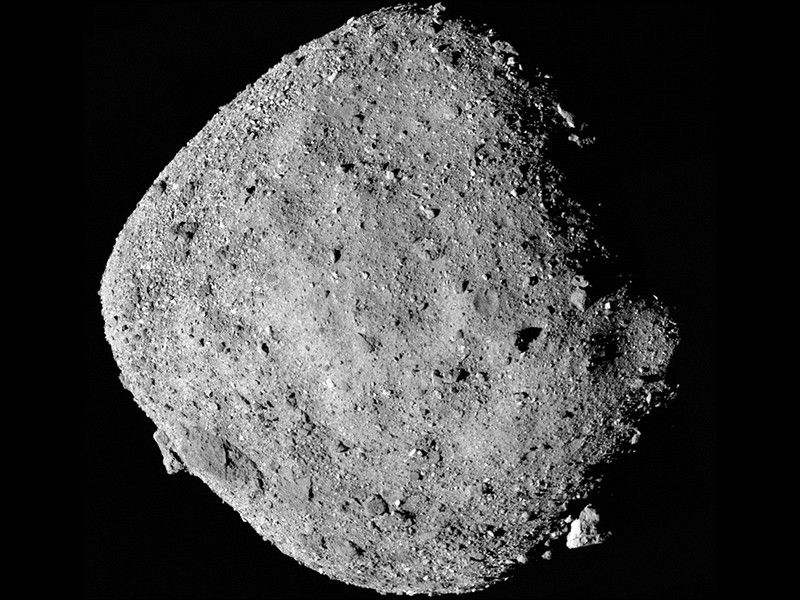
On September 24, 2023, a charred capsule no larger than a truck tire streaked across the dawn sky over Utah, deploying a parachute to gently settle onto the desert floor. Inside wasn't a man-made device, but a cosmic treasure: about 250 grams of dark dust and pebbles, collected from the surface of an asteroid named Bennu, over 200 million miles away. This triumphant end to NASA's OSIRIS-REx mission was just the beginning of the story.Months later, after scientists meticulously pried open the stubborn sample canister, their initial analysis revealed something extraordinary. This wasn't just generic space dirt. NASA announced that the Bennu sample contains abundant water locked inside clay minerals and a surprising wealth of carbon-rich, organic molecules.
For scientists, it was a eureka moment. For the rest of us, it might prompt a simple, profound question: Why should we care about a little water and carbon on a distant rock?
The answer rewrites our understanding of our own origins. This discovery provides the strongest physical evidence yet for a revolutionary idea: that the essential ingredients for life on Earth were not homegrown but delivered from the depths of space.
What Exactly Was Found? (The ingredients)
To understand why this discovery is so monumental, we need to look at what, specifically, was in that handful of asteroids.1. The Water Clue: Minerals from a Wet World
The initial analysis showed that a significant portion of the sample is made of hydrated clay minerals, particularly a type called serpentine. Imagine these minerals as nature's microscopic sponges. Their crystal structure is like a layered lattice that has chemically trapped and bound water molecules within it.What it means: Bennu itself is not an ocean world. However, these water-bearing clays are a dead giveaway. They tell us that Bennu's much larger parent body—a world that existed over 4 billion years ago—was drenched in liquid water. The heat from radioactive elements in that early planetesimal likely created warm, water-rich environments beneath its surface, perfect for this chemistry to occur. We are, in effect, holding a piece of a primordial, water-rich world.
2. The Carbon Clue: A Toolkit for Life
Even more exciting than the water were the organic compounds. In chemistry, "organic" simply means molecules built around a backbone of carbon atoms—the versatile element that forms the scaffold of all known life. The Bennu sample is rich in carbon, making up nearly 5% of its weight, and that carbon is arranged into complex structures.
Scientists identified compounds like polycyclic aromatic hydrocarbons (PAHs), which are stable, ring-like structures of carbon and hydrogen. They also found carboxylic acids, which are key components in metabolism, and other prebiotic molecules—chemicals that are the necessary precursors for amino acids, sugars, and the nucleotides that make up RNA and DNA.
What it means: Crucially, these are not signs of past life on Bennu. Instead, they are the unassembled pieces of the puzzle. They prove that the complex chemical pathways that can lead to biology are not unique to Earth but are occurring naturally in the void of space, on the surfaces of ancient asteroids.
The Cosmic Delivery Theory (Connecting Bennu to Earth)
Finding these ingredients is one thing. Understanding their cosmic significance is another. Bennu acts as a perfectly preserved time capsule from the dawn of our solar system.
Bennu is a "primitive" carbonaceous asteroid. This means it has remained largely unchanged since it formed from the swirling dust and gas of the protoplanetary disk over 4.6 billion years ago. It is a leftover building block, a piece of the solar system's raw construction material.
Now, picture our solar system in its first few hundred million years: a violent, chaotic place. Countless planetesimals and asteroids, many just like Bennu's parent body, were zooming on chaotic orbits, frequently colliding with young planets.
This brings us to the pivotal theory: The Late Heavy Bombardment.
During this period, the inner solar system, including the newly formed Earth, was pummeled by a rain of asteroids and comets. The young Earth was likely a hot, molten, and dry world, its own original water and lighter elements boiled away.
Here’s the revolutionary link: What if those impacting asteroids weren't just destructive? What if they were also deliverers?
Asteroids like Bennu, rich in water-bearing clays and organic carbon, would have been perfect cosmic delivery trucks. Upon impact, they could have contributed a significant portion of Earth's oceans (the water in your body right now may have space-rock origins) and dusted the planet's surface with a layer of prebiotic organic material.
The discovery on Bennu isn't just a curiosity; it's a smoking gun. We now have a physical sample of the exact type of material that scientists theorize seeded a sterile, young Earth with the essential starter kit for life.
What This Means for Us (The Implications)
This single sample from one asteroid carries implications that ripple outward, changing our perspective on everything from our past to our future.
Implication 1:
For Our Own Story on Earth: This discovery provides the most tangible evidence to date for the theory of panspermia—or more accurately, molecular panspermia. While it's unlikely Bennu carried full-fledged microbes, it almost certainly carried the potential for life. It strongly suggests that the fundamental chemistry that led to the first living cell on Earth has a universal, cosmic origin. We are, in a very real chemical sense, children of the stars (and asteroids).
Implication 2:
For the Search for Life Elsewhere: If the basic ingredients of life—water and complex organics—are this common, found on a random asteroid we happened to visit, then they are likely ubiquitous throughout our galaxy and the universe. Every star system with rocky planets probably went through a similar bombardment phase. The odds that the conditions for life exist on millions, if not billions, of other worlds just skyrocketed. The universe appears to be inherently prebiotic—primed and ready for life to emerge wherever stable conditions allow.
Implication 3:
For Science, Technology, and Our Future: Studying these pristine materials is like having a new, untouched textbook from the solar system's first chapter. It helps us understand planet formation with unprecedented detail. Furthermore, the types of carbon molecules found could inform new fields of chemistry or materials science. Finally, understanding the composition and structure of asteroids like Bennu is critical for future endeavors, whether that's planetary defense or the eventual use of asteroid resources.
V. Conclusion: A New Perspective
The journey of the OSIRIS-REx mission is a staggering feat of human ingenuity: we plotted a course to a spinning rubble pile a quarter-billion miles away, touched it for mere seconds, and brought a piece of it home. But the true grandeur lies not in the engineering, but in the message the sample carries.
This small, dark dust from Bennu connects us directly to our cosmic past. It tells us that the boundary between "Earth" and "space" is an illusion when it comes to our origins. The water in our oceans, the carbon in our bones, the very chemical foundation of life itself—all of it may have hitched a ride on asteroids during our planet's most violent epoch.
As we continue to analyze these precious grains, we are reading our own origin story, written in the language of chemistry and sealed in a time capsule for 4.6 billion years.
The final takeaway is both humbling and exhilarating: We are not just inhabitants of Earth. We are the product of the solar system itself. And if the universe so readily provides the ingredients for life, then perhaps, out there among the stars, others are stirring the same cosmic soup.


No comments:
Post a Comment